
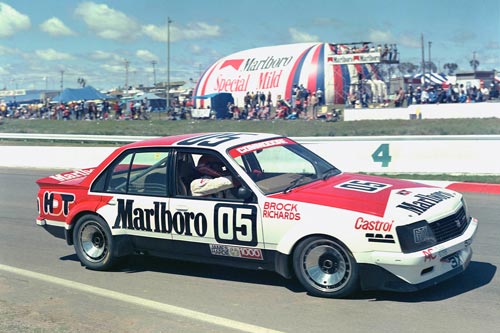
The 1981 Hardie-Ferodo 1000 was a rare miss for the Holden Dealer Team in an era of dominance for the factory operation.
Since re-joining the factory squad in 1978, star driver Peter Brock had enjoyed immense success.
Brock arrived when the team was entering a new era after dumping long-time manager Harry Firth for John Sheppard and developing the A9X into such a dominant weapon that CAMS was forced to change the regulations by the end of the decade.
In 1978, Brock achieved a clean-sweep of the major results including the Australian Touring Car Championship, Hang Ten 400 and Hardie-Ferodo 1000, while 1979 brought more of the same.
Despite narrowly missing out on the ATCC to privateer A9X driver Bob Morris, Brock continued his extraordinary run at Sandown before crushing the opposition by six laps at Bathurst.
A change in regulations arrived for 1980 brought an upheaval to the team when Brock was forced to purchase the team and through the support of select Holden dealers, led by Adelaide’s Vin Kean, was able to keep the band together.
The regulations changes forced the A9X to be retired in favour of the European-derived Commodore for the new season, which failed to hamper Brock’s dominance when he secured his third ATCC title, a sixth Hang Ten 400 crown and fifth Bathurst 1000 victory.
It was an unlikely Bathurst victory after Brock tangled with a class contending Holden Gemini on top of the Mountain.
The Commodore was also lacking in horsepower compared to Dick Johnson’s Ford XD Falcon and Kevin Bartlett in the Channel 9 Chevrolet Camaro as demonstrated in Hardie’s Heroes.
What saved Brock was Bartlett’s Camaro was hamstrung by rear drum brakes and Johnson infamously hit a rock after attempting to avoid a recovery truck having just lapped the HDT Commodore.
Although Brock scored his fifth win, the stakes were raised considerably for the first time since Allan Moffat led Ford’s attack during the early-1970s.
In 1981, Johnson emerged as a key rival having received donations by the public, which were matched by Ford Australia after a tearful, desperate interview during the Channel 7 Bathurst telecast.
Johnson went onto win the ATCC and Moffat broke Brock’s dominance in the newly renamed Castrol 400 to confirm his credentials in the Mazda RX-7.
The 1981 Great Race was set to be the most competitive in recent history due to Johnson’s rise, Moffat’s Mazda, the Camaro of Bartlett and the Falcon of Ford convert Morris were just a few arriving at the Mountain as contenders.
For the HDT, it was a frustrating event from the outset as the horsepower difference of the Chevrolet and Ford left the Commodore far behind.
Promoted by Marlboro as ‘Brock’s racing like the devil at Bathurst’ and he sure did during the early running.
A titanic struggle between Brock, Bartlett and Johnson provided a thrilling start to the race, but ended badly for the Holden hero.
An innocuous touch between Brock and Bartlett heading up Mountain Straight terminally damaged the HDT Commodore’s rear axle forcing it behind the pit wall for a long period of time.
John Harvey now upheld the HDT honours until a lightweight wheel the team was using for the first time failed at The Dipper and took out the class leading Chickadee Toyota Celica of future Bathurst winner Graeme Bailey.
Brock did return to the event prior to the race-ending crash at the top of the Mountain, with rival Johnson taking his maiden Bathurst victory alongside John French.
Ir proved the end of a successful partnership with Jim Richards for Brock, but opened the door for Larry Perkins to align with the HDT and form another formidable driver pairing.
This led to Brock scoring another hat-trick between 1982-1984 with Perkins.