
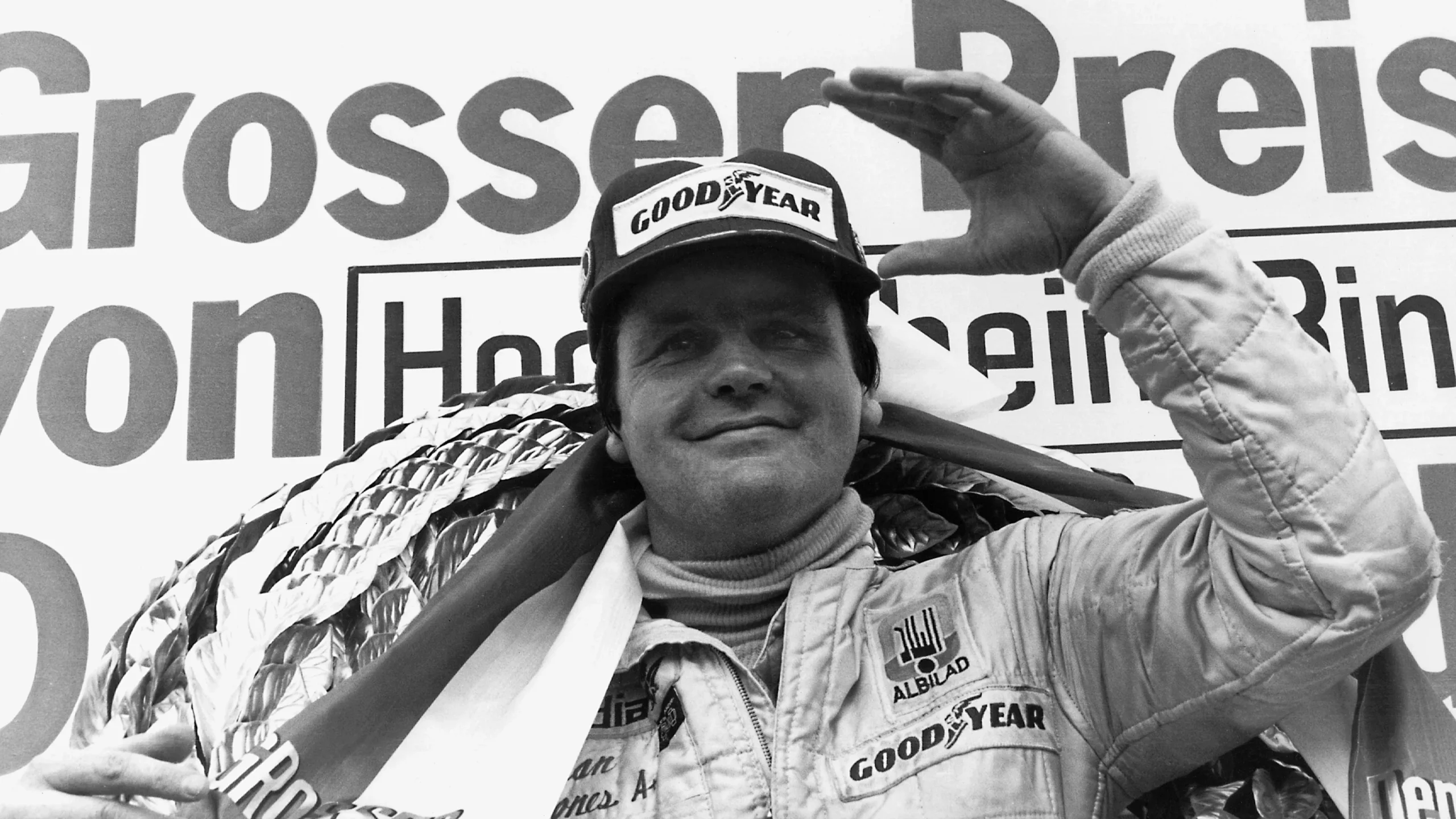
Australia last Formula 1 World Drivers’ Championship winner, Alan Jones has passed away aged 80.
Jones was noted for his uncompromising style and helped develop Williams into a dominant Formula 1 force.
Consumed by motorsport at an early age due to his father Stan’s successful career culminated in the 1958 Australian Drivers’ Championship Gold Star, Jones soon decided to build his own and this took him overseas.
Money was the sticking point preventing Jones from making in-roads into the European market early on, but a partnership with fellow Australian Brian McGuire in trading used cars helped bankroll their careers.
Things started to build for Jones in 1971 when a modest season in Formula 3 attracted the March. Although this came to nothing, Jones continued to build a solid reputation in Formula 3 and nearly won the 1973 title, albeit a misfire at the Brands Hatch season finale cost him the crown.
After making the jump to Formula 5000 in 1974 through the aid of Harry Stiller, it was this man to aided Jones’ journey into Formula 1 by purchasing a Hesketh 308.
Jones made his debut at the disastrous 1975 Spanish Grand Prix at the Montjuic street circuit where Rolf Stommelen’s crash killed five spectators. When Stiller’s program ended after only four races, Jones deputised for the injured Stommelen at Graham Hill’s team and finished a best of fifth at the Nurburgring to score his first points.
This led Jones to race for John Surtees’ team in 1976 for his first full-season campaign, which included fifth place finishes at Spa and Silverstone, while a fourth came at the season-ending Japanese Grand Prix.
Jones chose to sit out the 1977 season instead of continuing with Surtees, but received a call to join the small Shadow team as replacement to Tom Pryce after he was killed in South Africa following a freak incident.
It proved the right call as Jones secured his maiden Grand Prix win at Austria’s Oestreichring and was third at Monza on the way to seventh in the title standings.
A determined Frank Williams and Patrick Head snapped Jones up as part the rebuild of his eponymous team following many false dawns. Jones also had interest from Ferrari, but Gilles Villeneuve got the seat.
Progression was swift for the Williams-Jones partnership when it achieved second at the 1978 United States Grand Prix.
Much to Jones’ dismay, it was teammate Clay Regazzoni scoring the first Williams victory at Silverstone in 1979 rather than himself after the engine overheated.
Jones went on to score the next three victories and added a fourth in Canada to finish the season third in the standings.
Everything clicked in 1980 for Jones and Williams when the partnership won five Grands Prix to take the first World Drivers’ Championship to be won by an Australian since Jack Brabham in 1966.
Jones also returned to his homeland and replicated his father by winning the Australian Grand Prix, though this was not at this stage part of the Formula 1 World Drivers’ Championship.
Success came amid a fierce rivalry with teammate Carlos Reutemann, which may have cost Jones back-to-back titles in 1981 and a longer initial career after announcing his retirement towards the end of the season.
Jones won the final race of the 1981 season, strangely run in the car park of Las Vegas’ Caesar’s Palace casino.
Returning to Australia during this retirement, Jones made his Bathurst debut alongside Melbourne privateer Warren Cullen and dabbled in local touring car racing.
Further stints first with Arrows, then Team Haas failed to elevate Jones back into the Formula 1 winner’s circle, but he did thrill fans in the 1985 Australian Touring Car Championship as teammate to Colin Bond in a factory Alfa Romeo GTV6.
Runs in sports cars came through an association with Toyota during the late-1980s before basing himself in Australia from then on.
Linking with Frank Gardner initially driving the Benson and Hedges Ford Sierra RS500 Cosworths, then the BMW M3s, Jones matched it with the touring car regulars.
Dominance came in 1993 for the new Ford Falcon vs Holden Commodore formula where Jones finished second to Peter Jackson Racing teammate Glenn Seton in the title, while bolstering his uncompromising style highlighted by his drive at Symmons Plains.
Branching out on his own for 1996 alongside Ross and Jim Stone failed to deliver the success he enjoyed at Glenn Seton Racing, but he was still a contender his final full-season campaign in 1997.
It was during this time, Jones endured heartbreak at the Mountain when his Pack Leader Racing Ford Falcon burst into flames during the early running of the Bathurst 1000 in what was set up to be his best chance yet.
From there, Jones was a valued co-driver at Toll Racing and Dick Johnson Racing until his final Bathurst start in 2002.
Jones during this time was an expert commentator alongside Darrell Eastlake for Channel 9’s motorsport coverage, before joining Network 10 as part of its Formula 1 broadcast.
Condolences to the Jones’ family and friends.