

Audi changed its approach to motorsport in the wake of Group B rallying’s death at the end of 1986 by using its Quattro technology in circuit racing.
The all-wheel-drive system changed rallying forever as Audi dominate the early 1980s against the two-wheel-drive competition and was aiming to do the same in the United States contesting the SCCA Trans-Am Series.
What spawned this program was a fraudulent 60-minutes report displaying ‘unintended acceleration by the 5000 sedan, but it was proven the test Audi was rigged to shift into gear to cause the forward motion.
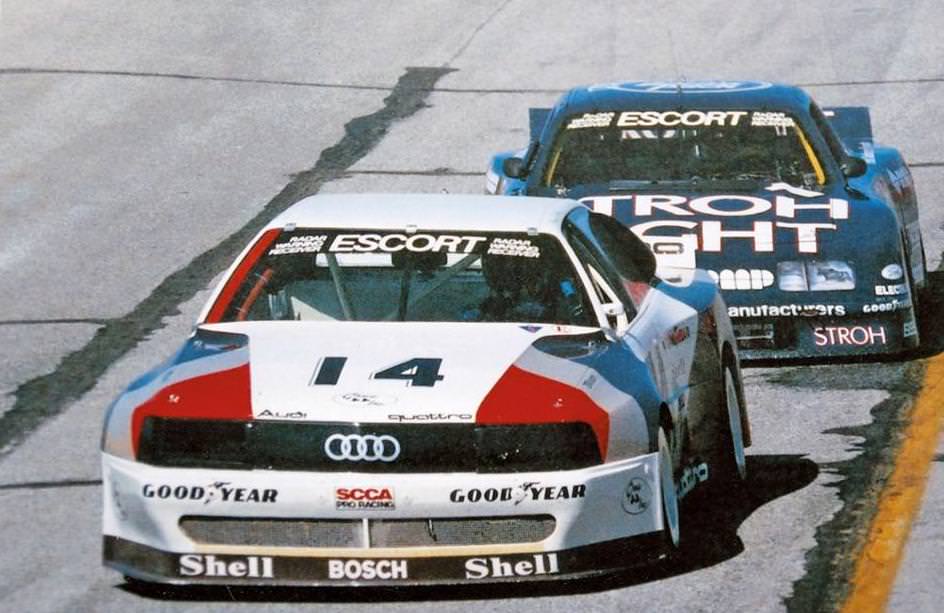
In response, Audi entrusted Bob Tullius’ Group 44 to enter the SCCA Trans-Am Series to display the advantages of the Quattro system in extreme competition.
Group 44 had displayed its wares with Jaguar previously and Audi’s 200 model, with assembly of the racing units for the highly modified Trans-Am regulations.
Not only did the 200 use Quattro all-wheel-drive, but it also used a powerful turbocharged five-cylinder engine featuring a unique note.
Testing started at the Oestrreichring, then Paul Ricard in France before the program transferred to America at Road Atlanta.
Competition came from a pair of factory Ford Merkur XR4Tis, Chevrolet Corvette and Camaro, Oldsmobile Cutlass, Porsche 944, Nissan 300ZX, Pontiac Firebird, Mazda RX-7 and much more.
Spearheaded by sports car veteran Hurley Heywood, Audi dominated the season by winning seven of the 13 rounds on the way to the Drivers’ and Manufacturers’ title.
The Audi was so dominant the SCCA changed the rules to accommodate just American manufacturers powered by V8 engines. Similar to what happened in Australian racing at the end of 1992.
Audi moved to the IMSA GTO Championship for 1989 where it competed against Ford’s Mercury brand, Nissan, Mazda and Chevrolet.
Having proved its point, Audi continued to use its Quattro technology to dominate Super Touring during the mid-1990s.