

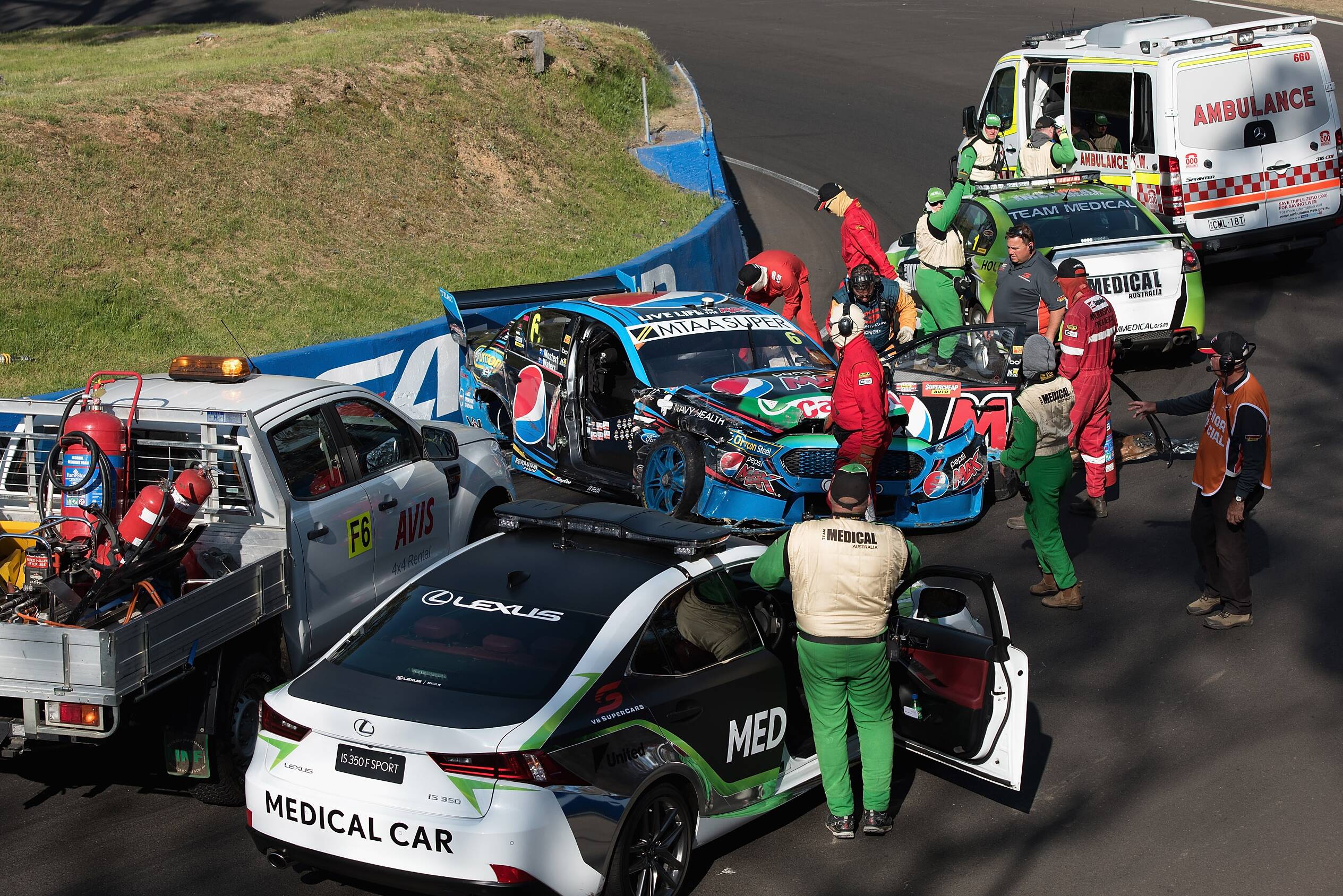
Driver safety continues to be a strong priority of the Repco Supercars Championship and Chaz Mostert’s frightening crash during Qualifying for the 2015 Bathurst 1000 highlighted not only a need for change, but also how strong the Car of The Future product was.
Motorsport is inherently dangerous, but every effort is made to protect drivers, teams, event staff and spectators alike. However, in rare cases there are injuries and Mostert’s enacted change due to what he suffered.
A decade ago, Mostert was targeting back-to-back Mountain success after his last lap efforts delivered victory the previous year, but it all came unstuck in dramatic circumstances just prior to Forrest’s Elbow.
On the run approaching Forrest’s Elbow, Mostert clipped the inside wall and was sent heavily into the outside concrete where the Pepsi Max Falcon FGX nearly went over the edge clipping a marshall’s post along the way.
The impact led to Mostert hitting the gear lever resulting in a broken femur to end his season there and then, forcing him out of his title hunt.
When the Car of the Future (CotF) platform was released for the 2013 season, driver safety was the key focus.
The fuel cell had been moved forward of the rear axle to prevent a fire in the event of severe front-to-rear contact, such as the incident involving Karl Reindler and Steve Owen at Wanneroo in 2011.
The biggest change came in the form of a revised driver seating position in an effort to further enhance safety in a side intrusion crash; the seat was moved inboard and further towards the rear compared to the previous ‘Project Blueprint’ chassis.
While this detail certainly helped Mostert when the driver’s side of his Falcon hit the wall, his legs were still in danger.
The seat used by Supercars is highly sophisticated in terms of the way it protects the driver’s upper body, but little was in place at the time to protect the driver’s legs, leaving them exposed to hitting the steering column, or in Mostert’s case, the gear lever.
Longtime NASCAR and IndyCar team owner Roger Penske entered the sport that same year in a partnership with Dick Johsnon Racing and set about convincing Supercars that the driver’s legs needed better protection.
NASCAR stock cars had long used a ‘safety cell’ inside the car that almost completely surrounded the driver, keeping them as safe as possible in the event of an accident, whereas Supercars drivers were still much more exposed.
“The seat was already the highest standard you can have to FIA ratings, but [Roger] Penske came to us with the idea for a foot-tray modelled off their NASCAR which could make it even safer. From there we got the best brains in pit-lane to develop it.” then-Supercars Technical Director David Stuart said.
The new safety device to protect driver’s legs was made mandatory in all cars towards the end of 2016 after Lee Holdsworth sustained injuries to his knee, back and pelvis from a heavy crash in Darwin that year.
Since the introduction of this protection, no drivers have suffered leg injuries in Supercars crashes.
The most recent driver safety talking point came from the 2024 Adelaide 500 where two competitors were sidelined with concussion symptoms after hitting the outside wall at Turn 8, to again bringing track safety to the forefront.