
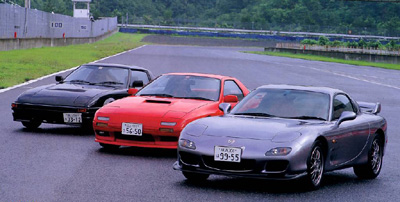
The Mazda RX-7 proved a beast on and off the track, with the nameplate maintaining an aura more than 20-years since production ended.
Lasting three generations during a 24-year stint in the marketplace, the RX-7 was a dominant force and enjoyed a successful stint in Australia leading to Mazda producing a special version dedicated to Mount Panorama, Bathurst.
The unique Wankel Rotary engine was the RX-7’s centrepiece throughout its journey along with its two-door, rear-wheel-drive configuration.
Matasaburo Maeda led the design of the RX-7 (coincidentally his son Ikuo designed the RX-7’s successor, the RX-8) where the lightness and size aided by the rotary’s location behind the rear axle made it a great handling sports car.
Featuring a wedge-shaped body design utilising pop up headlights, a long front and sloped rear for its first three series.
Australia received the RX-7 Finale model to send off the first generation specified by it being fully optioned, ‘Last of a Legend’ plaque and blackened areas around the rear hatch.
Turbocharging was also introduced in 1983 further amplifying the performance of the first generation RX-7 and was a forerunner to the new model released in 1985.
Enter the FC.
Smoother lines, but still maintaining the long-front, short-back design of Maeda, the FC designed by Akio Uchiyama was a balance between comfort and pure performance unlike the previous generation.
Independent rear suspension, more responsive race and pinion steering, standard disc brakes and Mazda’s Dynamic Tracking Suspension System proved solid improvements for the FC.
A convertible was introduced in 1988 as production of the FC ended three years later in anticipation of the third and final generation.
Further refining the original shape to feature a smoothed out body design, which was spearheaded by trio Wu-Huang Chin, Tom Matino and Yoichi Sato.
A twin-turbocharged 13B-REW engine upped the power stakes to 206 kW, with Japanese manufacturers entering a golden age of sports car releases.
Sequential twin-turbocharging was developed alongside Hitachi aligning the two units to produce better performance at lower and higher rev range.
Locally, the RX-7 was part of a homologation influx in production racing when the SP was introduced to tackle the challenges from Porsche, BMW and Lotus.
Production ended for the FD in 2003 amid the entry of the RX-8, which didn’t match its predecessor in performance much to fans dismay.
Motorsport was a key component for the RX-7 as the nameplate ran at Le Mans, was a winner of the British Saloon Car Championship with Win Percy and launched Allan Moffat back in a big way back into the Australian Touring Car Championship.
Moffat enjoyed great success highlighted by the 1983 title before the relationship ended when Group A was introduced by the finish of the next year.
RX-7s continue to dominate production car racing courtesy of Garry Walden and Peter Fitzgerald ahead of these types of sports cars being banned in 1991.
The FD won three James Hardie Bathurst 12 Hours led by team manager Allan Horsley and this continued when the race moved in 1995 to Eastern Creek spearheaded by the new SP.
Sydney Rotary expert Ric Shaw continued to win races until 2005 in various production car-based categories in RX-7s.
There are rumours surrounding a comeback for the RX-7, but it is yet to come to fruition.