
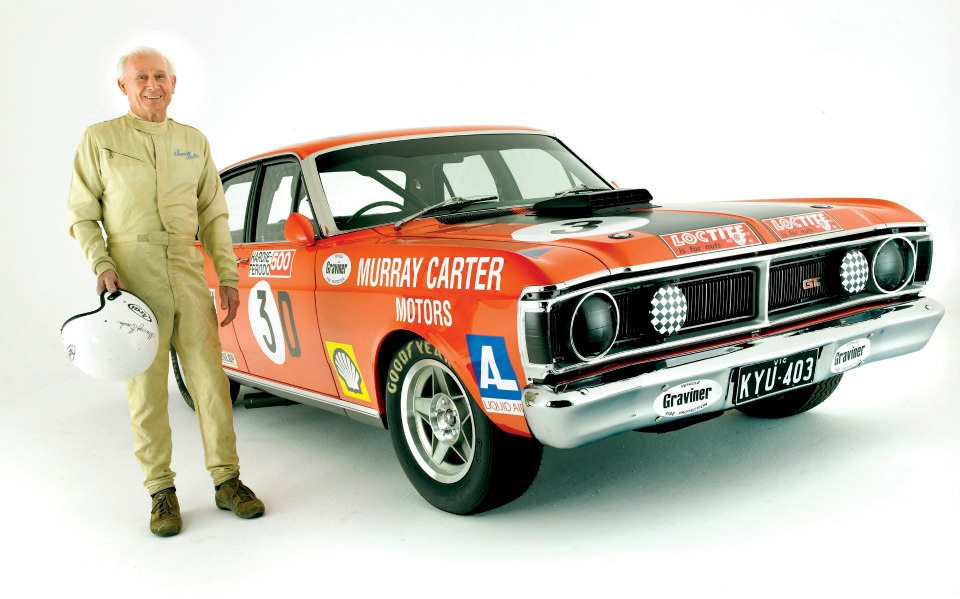
Murray Carter was a loyal Ford ally despite receiving limited back door support and was one of the key personnel to homologate the XD Falcon for touring car racing at a time when the Blue Oval wanted nothing to do with motorsport.
Back when he was a privateer in the 1970s, Carter was considered a veteran, so it’s amazing he was driving competitively up until 2017 in his Chevrolet Corvette Sports Sedan.
Starting in motorcycles, then turning to four wheels via a Jaguar XK120 during the 1950s, Carter was runner up in the Australian GT Championship to Bob Jane in 1963 and raced a large Ford Customline in the first Armstrong 500 at Phillip Island.
It was a decade later before Carter contested the event now named the Hardie-Ferodo 500 and held at Mount Panorama, Bathurst in New South Wales.
Carter featured in one of the Hardie-Ferodo 500’s most memorable moments when an axe was taken to his Ford XW Falcon GT-HO Phase III when a damaged guard fouled a front tyre.
It was Carter, who played a vital role in backing up Allan Moffat’s 1973 Australian Touring Car Championship success when the factory Ford driver’s Falcon GT-HO Phase III was stolen from an Adelaide dealership.
Moffat’s stead was taken from the Stillwell Ford dealership in Medindie and found a week later abandoned in the Adelaide Hills after running out of fuel.
Loaning his privateer Falcon to Moffat to score second to Peter Brock at Round 6 of the ATCC at Adelaide International Raceway, Carter sat on the sidelines to ensure the factory team held its championship lead.
From there, Carter continued to be a loyal contender to the Blue Oval even when there was a limited number racing due to a lack of support and involvement from the factory.
This came to ahead approaching the 1980 season when the XC Falcon Hardtops and Torana A9Xs were to be phased out. CAMS had earmarked the XD Falcon and VB Commodore as the future, but Ford was reluctant to re-join the touring car circus.
It was Carter, Ford designer Wayne Draper and Sydney privateer Garry Willmington, who combined to ensure the Falcon was represented on the grid. The performance of the new Falcon due to the smart homologation play led to it being using the weight from a bog standard ‘Taxi Pack’.
Although Carter and Willmington didn’t enjoy success during this period, but the promise demonstrated by both re-invigorated Queenslander Dick Johnson to construct his own XD Falcon.
Carter did stray away from Ford during the latter phase of the second incarnation of Group C by joining the Mazda RX-7 fleet alongside the factory supported effort of Moffat.
Limited options for the international Group A regulations forced Carter to build a Nissan Skyline DR30 before returning to a Ford, but this time the European Sierra RS500 Cosworth.
This proved a struggle due to the technology and associated cost leading to a scary moment at Phillip island for Carter when the Sierra was engulfed by flames.
Turning to production car racing, Carter successfully race Mazda 626s and Nissan Pulsar SSSs before turning his hand to GT-style racing by building up a Chevrolet Corvette for Nations Cup competition.
State racing was next and he raced a variety of Corvettes until his retirement.
Carter remains best known for his stint as a Ford privateer and was one of the top competitors for a sustained period of time.