
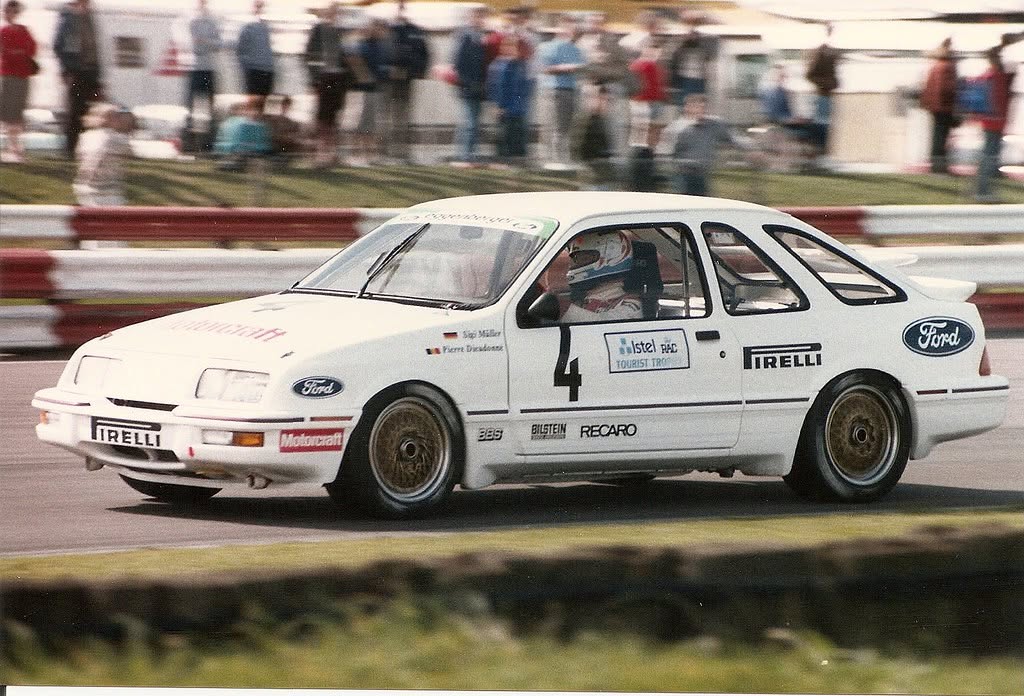
Before the Ford Sierra RS500 Cosworth dominated on the world stage, there was the Merkur XR4Ti.
The 1986 European Touring Car Championship marked a new era for Ford due to a new association with Swiss ace Ruedi Eggenberger and the bolstering of its program through the XR4Ti.
European manufacturers including BMW, Audi and Mercedes were enjoying great success in the US market leading to Ford putting in plans to emulate this by introducing a premium sub-brand to sell models it already sold in the United Kingdom and Germany.
Thus, the Merkur brand was born.
Merkur ran into problems before it started as the European-produced Sierra was forced into a re-brand due to Oldsmobile already having the rights to this name (albeit spelt Ciera), so the XR4Ti was born.
Built in Germany, the XR4Ti was a dramatic departure from what Ford had previously produced led by the futuristic exterior design.
Instead of the V6 used in the European Sierra, the XR4Ti utilised the 2.3-litre Pinto four-cylinder used in the Mustang SVO, Thunderbird Turbo Coupe, Mercury Cougar XR7. It was an impressive engine, which outperformed its European rivals in addition to Ferrari.
Just as all this was happening, Group A was on the rise during the mid-1980s featuring the likes of Jaguar (later Rover), BMW, Alfa Romeo, Mercedes and Volvo.
Ford’s motorsport boss Stuart Turner wanted to join the championship and first recruited leading ace Andy Rouse to lead the development in the British Touring Car Championship during the 1985 season.
Rouse went onto win the title in the Ford’s debut season, but the European Touring Car Championship was gaining momentum and it was next on the XR4Ti’s radar.
Eggenberger Motorsport was involved with BMW during Group A’s early days, before aligning with Volvo to develop its 240 Turbo into a championship winner by 1985.
A new challenge emerged for Eggenberger Motorsport when it took up the development of the XR4Ti.
Two XR4Tis were built up for the 1986 European Touring Car Championship to go up against one of the strongest fields witnessed to this point led by the RAS Sport Volvos, Schnitzer BMW 635CSis, Tom Walkinshaw Racing Rover Vitesses in addition to the Australian Holden Commodores of the Mobil HDT and Grice concern.
Eggenberger’s tilt on the ETCC was led by Brit Steve Soper, German journalist turned race driver Klaus Niedzwiedz, Siegfried Muller and Pierre Dieudonne.
Early season events were tough for the Eggenberger team, but 10th at Brno indicated progress by Round 5.
A further display of this was at the following event in Austria when Muller and Dieudonne finished third, but were disqualified for use of illegal fuel.
Controversy was never far away during the 1986 season amid manufacturers pushing the regulations to the limit and subsequent protests ensured plenty of drama.
Second at the Nurburgring and seventh in the 24 Hours of Spa emphasised the increased performance of the XR4Ti.
The maiden win for the XR4Ti came at Estoril’s season finale for Niedzwiedz and Soper, which led perfectly into the Sierra RS500 era.
Much of the learnings taken from the XR4Ti played an important part in turning the Sierra RS500 into a world beater.
One of the Eggenberger Motorsport XR4Tis made its way to New Zealand for Neville Crichton and was raced by Denny Hulme in multiple Australian Touring Car Championship events in 1987, but the RS500 was already seconds ahead by then.
This XR4Ti re-appeared fully restored in 2022 and highlights an important part in Ford’s touring car history.