


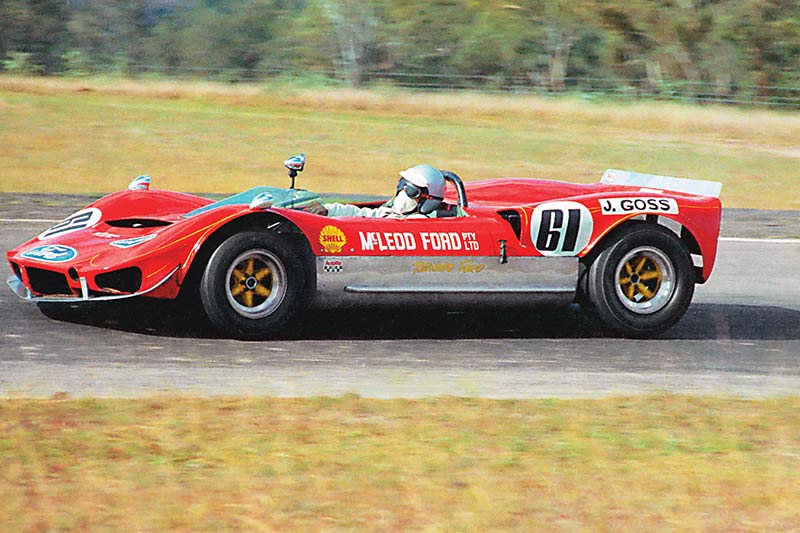
The Ford Tornado was a sports car full of ingenuity and launched the career of two-time Bathurst 1000 winner John Goss.
On the outside, it was aerodynamic in appearance and provided engineering solutions on the inside as part of a simple mechanical layout.
It was a very quick package as proven by the Tornado’s ability to reach 150mph at Longford and was on par with the factory-built examples of the time.
Construction of the Tornado began in 1966 and Goss himself made the fibreglass body shell.
Built with the aim of winning the top Tasmanian sports car against the Lotus 23 of Alan Ling and the Ross Ambrose Mildren Maserati, Goss had his work cut out.
Although the Tornado featured Volkswagen suspension components went it first came on the scene, more sophisticated parts were sort and installed.
Goss fabricated the chassis and ensured it was lightweight, while rigidity came from bent tubes to form a triangular design.
Humber Vogue uprights at the front suspension alongside the lower and upper ball joints, fabricated top and modified Herald-source bottom wishbones.
Rear suspension was formed by Morris 1100f front uprights, the top ball joint retained.
Steering came from the Herald, while it was left-hand-drive to suit Baskerville and Symmons Plains.
The steering wheel and pedals were custom made alongside the seats.
Amazingly the two fuel tanks of 30-gallons total were home made, positioned on the outside of the frame rails. Each was baffled and linked front to rear in order to drain equally.
BMC provided the brakes, including the 2”inch calipers pressing onto Cortina discs. Rear brakes were cooled by a nifty scoop in the bodywork.
Light wheels sourced from a Lotus 32B and alongside the chassis make the Tornado a light build. In fact, Goss believed the body was too heavy, but the aerodynamics equalled this out.
Goss went down the Ford route in terms of engine due to its lightness and how compact it was. Found in the XP Falcon, the engine featured a 12-port head, Weber manifold flanges and 40mm carburettors.
Exhaust parts were designed by Goss, a Wade 104A cam, Repco single valve springs and modified XT Falcon oil pump using Castrol R40 oil.
The clutch is an early Fiord pressure plate adapted for nine Repco springs, an 11”inch flywheel, VW drive splines and this is coupled to a VW gearbox featuring an Elfin four-speed close ratio gears.
Lap times were impressive not only in Tasmania where the Tornado held the record at Baskerville, but when it ventured to Victoria and New South Wales.
Raced when he moved to Sydney, Goss moved into Formula 5000 and Series Production through his workplace at McLeod Ford leaving the Tornado on the sidelines for 1972, then later sold.