
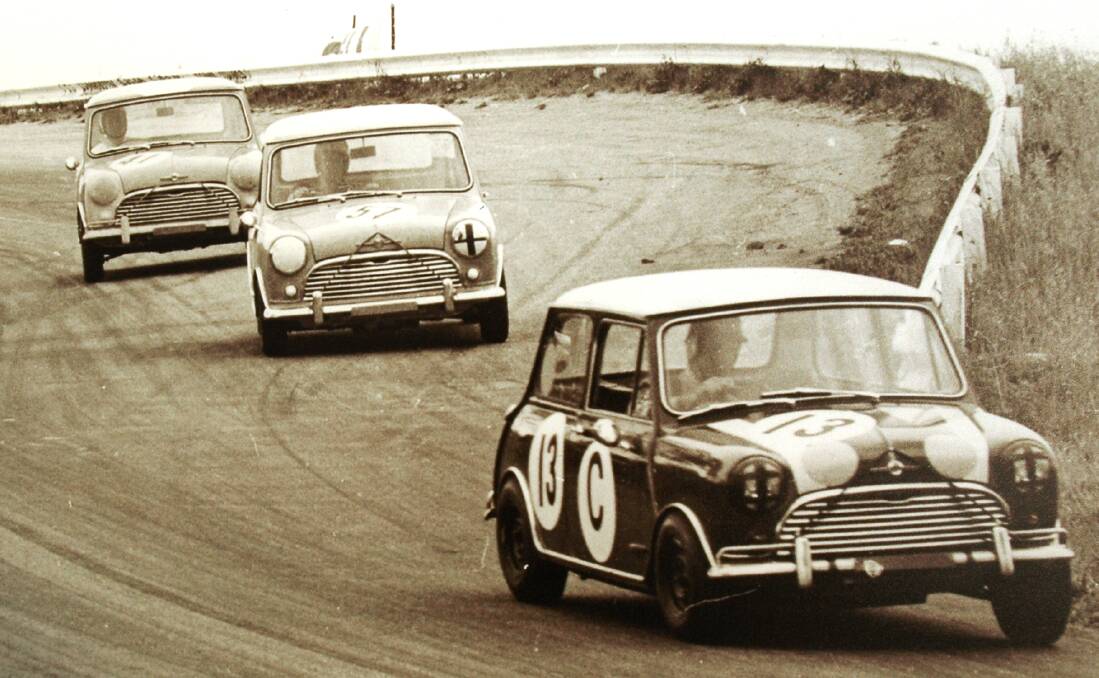
The British Motor Corporation’s Australian arm chose the perfect time to mount a meticulous attack on the Bathurst 500 and succeeded in dominating the event 60-years ago.
Arriving in the middle of a Ford dominated era between the Cortina GT and the V8-powered Falcon GT, BMC’s success at the Mountain highlighted the technical knowhow required to conquer what was soon becoming Australia’s most important race.
The race was going through a few changes itself including a change of naming rights from shock absorber manufacturer Armstrong to Irish tobacco brand Gallaher, while classes were change to reflect Australia’s move to decimal currency.
Further to this change of class structure, a new minimum number of 250 units of a particular model were required to be eligible instead of the previous 100 mainly in response to Ford Australia’s Cortina GT 500.
Ford was not officially represented on the grid in 1966 due to the lack of viability to build a new GT 500 and the launch of the new XR Falcon GT ensured the Cortina was redundant.
With Ford a no show, the plucky Mini rose to outright contender powered by a 1275cc engine, two long range fuel tanks, engine oil cooler, improved Hydrolastic suspension and larger brakes ensured it had all the requirements to last the 500-mile torture test.
Out of a field of 53 entries, 24 were Minis in the 1966 Gallaher 500 of which 17 were the high performance Cooper S variant.
Drivers to be behind the wheel of Minis in the race included future Great Race winners Fred Gibson, Bruce McPhee, Barry Mulholland, Barry Seton alongside the likes of John Leffler, Frank Matich and Ford star Harry Firth.
BMC’s Australian arm combined local talented drivers with its top rallying stars across three entries. The stars of rally were coming out to Australia to contest the Southern Cross Rally a week after Bathurst, which allowed some of the disciplines now legendary drivers to contest The Great Race.
Mini ace Brian Foley was drafted in and was joined by British rally ace Paddy Hopkirk, Finn Timo Makinen paired with John French until Steve Harvey was forced to replace the European champion due to clashing commitments.
Completing the line-up was Makinen’s Finnish counterpart Rauno Aaltonen co-driving with Sydney-based driver Bob Holden.
Importantly, Holden was the only qualified mechanic in the driver line-up and this played a part in his team’s success in the race.
Cunningly, Holden’s relationship with apprentice David Bradford proved pivotal when it was acknowledged the Mini earmarked for he and Aaltonen was down on power compared to the other two.
Holden enjoyed a friendship with BMCA public relations boss Evan Green. After learning his engine was down on power, Holden convinced Green to allow him to take his Mini back to his workshop where his team of mechanics, Bradford and dedicated staff of Lynx Engineering rebuilt the Cooper S.
Following a full strip down of the components held across three nights meaning the Mini was re-assembled multiple times and parked at BMCA headquarters to not raise the suspicions of his teammates.
A final drive from Sydney to Canberra just to bed the components in completed Holden’s masterful preparation, but to keep this from his teammates restraint was needed in the early stages of the race week to ensure the night activities remained a secret.
Aaltonen needed some convincing as he was keen to be fastest of his teammates, but the Finn obliged and surprised many with his pace during the race.
Taking the lead on lap 2, Aaltonen then engaged in a massive battle with teammate Foley until the latter limped into the pits with a crankshaft bearing failure.
Holden’s preparation was vindicated as his was the sole BMCA Mini left after French’s entry was also out of contention with wheel damage, albeit due to a collision.
From there, Holden and Aaltonen dominated the race, although privateer Rob Haylen put up a challenge after the first round of stops were completed. This ended when Haylen’s Mini blew a tyre at McPhillamy Park and collided with the wooden ‘safety’ fence.
This left Holden a lap and a half ahead of his opposition leaving Aaltonen to complete the rest of the 130 lap duration to greet the chequered flag.
Minis filled the first nine places outright, with a VC Valiant V8 automatic breaking the monopoly in 10th.
However, this race marked the end of an era due to the influx of reliable V8 power in 1967 by Ford ensured four-cylinder outright contenders were destined for class battles only in the future.