After more than 15-years of taking on the factory teams, Allan Grice achieved his longstanding goal of achieving victory at the Bathurst 1000.
Four decades on, it remains the last time a privateer has greeted the chequered flag at the Mountain and was the culmination of a battled hardened season in Europe taking on the world’s best.
Grice’s European challenge coincided with Sydney privateer Graeme Bailey’s desire to win Australia’s Great Race and the link between the two was ace mechanic Les Small.
Bailey’s goal to win Bathurst was fuelled by co-driving with Peter McLeod in the IMB Team Wollongong Holden VK Commodore, which ran in the top five before retiring due to the Getrag gearbox broke on lap 126.
Small was involved in the build, as was Gosford Performance’s Peter Pattenden and both were to play a crucial role in the Bathurst success next year.
Following the near-miss with McLeod, Bailey went all-in for 1986.
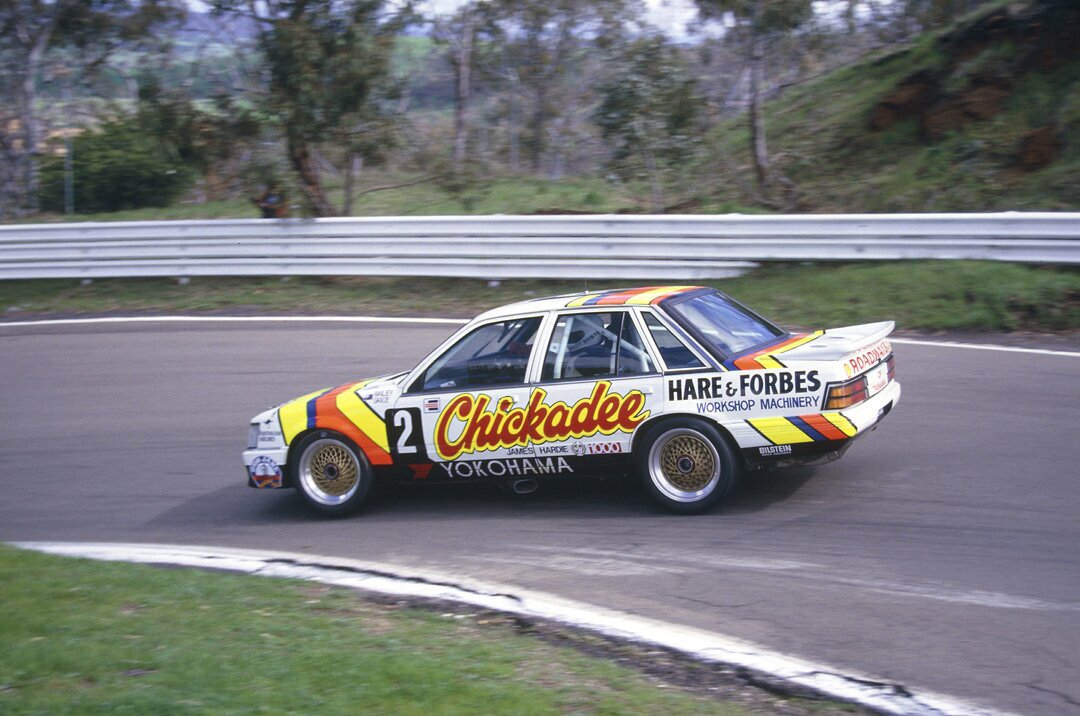
Owner of Chickadee Chickens, Bailey set his Bathurst attack up by enlisting Small and his Roadways concern to build a new Holden VK Commodore for the purpose.
Grice completed the shakedown and handover at Amaroo Park ahead of Bailey giving the virgin white Commodore its debut in the opening round of the 1986 Australian Touring Car Championship at the same venue.
The debut didn’t last long as despite a great start, contact was made during the second lap leading to a deflating tyre pitching Bailey into a race-ending spin.
Although Bailey failed to return to the ATCC until Round 6 at Surfers Paradise International Raceway, he did join Grice in Europe for the opening events at Monza and Donington Park.
Grice’s Australian National Racing Team campaign featuring a rotation of star drivers had fallen over when Peter Brock and the Holden Dealer Team announced their own European program forcing the privateer to enlist pay drivers instead.
The plain white Roadways Commodore was quick in Italy and Grice shook up the established contenders with his no-holds barred racing style. In short, he wasn’t going to be out muscled.
Results lacked, but the Europeans were on notice of the Commodore’s potential and much to Grice’s pleasure, the Roadways’ package had the measure of the HDT.
Most importantly, the learnings from Europe were transferred to Bailey’s VK Commodore in Australia being fettled by Pattenden.
Stronger suspension struts to take on the kerbs, tyres and fuel were some of the key areas focused on to develop the ultimate VK Commodore.
The improved VK Commodore was re-homologated with a detuned engine to fit in a lower class and therefore a lighter weight, while a new aero kit further aided the package.
It arrived at the right time as manufacturers were starting to take the Mickey out of the ability to develop Evolution models enabling 500 of these to be produced. The arrival of Ford’s Sierra RS500 arguably began the downfall of this rule.
As proven by Grice’s flashes of pace during the 1986 European Touring Car Championship against the likes of BMW’s 635CSi, the Ford Merkur XR4Ti, Volvo’s 240 Turbo and Tom Walkinshaw’s horde of Rover Vitesses, the competition was fairly equal. Although the politicking was fearful.
In Australia, it was much the same as JPS BMW introduced the 325i alongside the 635CSi, Volvo was there as was Alfa Romeo, Holden, Dick Johnson’s Ford Mustang, Mitsubishi, a lone Merkur XR4Ti and the new Nissan Skyline DR30.
The racing was close all season, but New Zealander Robbie Francevic took the title after a hot start to his campaign taking three out of the opening four rounds to defeat the Nissan of George Fury.
Holden and BMW also took round victories.
Bailey contested five rounds, finishing a best of fourth at the Oran Park finale after an entertaining battle with the reigning champion Richards and the incoming title winner Francevic.
The first true indication of the Chickadee Commodore’s pace was to be at the Sandown 500 where Grice made his first Australian start since taking on Europe.
Bailey’s Commodore featured all the latest upgrades developed in Europe and was in contention to win until a delayed pit stop dropped the team to third behind the pair of Peter Jackson Nissans.
The Roadways team was not downcast by the result with the speed displayed at Sandown holding the squad in good stead leading into Bathurst.
A bomb scare at Heathrow Airport delayed Grice’s arrival at Bathurst, but he set the fastest time in Thursday morning practice before qualifying on the front-row for the race.
Grice led away from the start and went onto dominate the race despite a spin during Bailey’s sole-stint, with later a tell-tale oil leak providing slight concern.
The Chickadee Commodore remains one of the best remembered Bathurst winners due to its day-glo colours and being the first of Grice’s triumphs.
After competing in the hands of Bailey in the Australian Grand Prix support race, the Chickadee Commodore was retired and remains under the ownership of its original custodian restored to 1986 Roadways specifications.
It was the first of two Bathurst successes for Grice, with the second coming against the odds in 1990 for the factory Holden Racing Team.